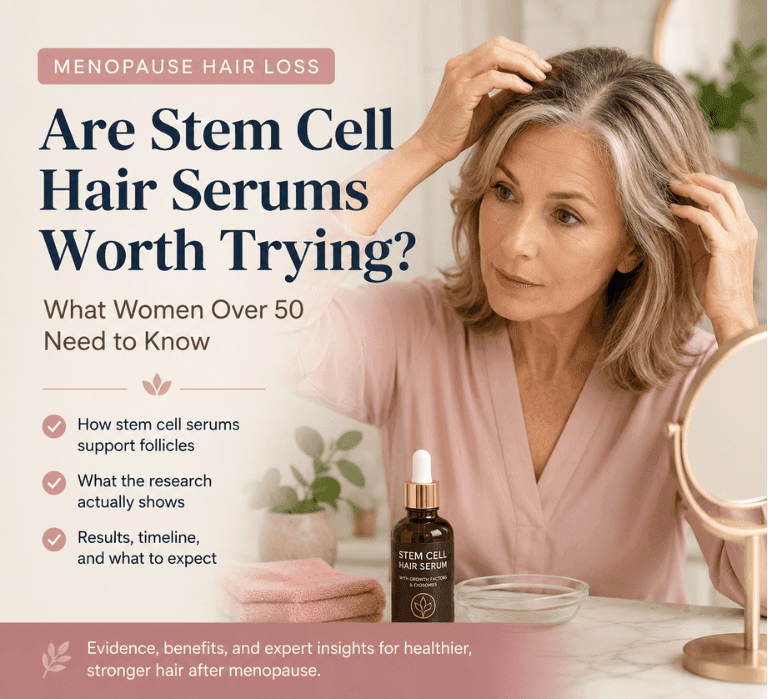

For some women, stem cell hair serums may offer a promising option when traditional menopause hair loss treatments fall short. These regenerative treatments, such as CALECIM® Professional Hair Serum, are intended to support follicle signalling and scalp health rather than simply masking thinning or temporarily coating the hair shaft.
Stem cell hair serums are a new regenerative option that may enhance hair density, scalp health, and follicle activity, promoting hair regrowth.
According to the American Academy of Dermatology, female pattern hair loss can appear as a widening part or widespread thinning and is more common after menopause. Meanwhile, PubMed reports that preclinical exosome research for hair loss is promising, but data showing safety and efficacy remain limited.
Stem cell hair serums may appeal to women who want a non-chemical approach focused on follicle support, scalp health, and hair density, rather than solely stimulating growth.
Unlike shampoos or cosmetic thickening products, regenerative hair serums are designed to interact with the scalp environment and follicle signalling pathways. Many use growth factors, proteins, cytokines, or exosome-derived ingredients intended to support sluggish or stressed follicles.
f you want a clearer breakdown of how popular actives are used in an over-50 routine, my guide to skincare ingredients every woman over 50 should know explains peptides, antioxidants, hydrators and the ingredients I approach more carefully.
This distinction matters because menopause-related thinning often involves more than simple shedding. Hormonal changes, follicle miniaturization, inflammation, and age-related slowing of the hair cycle can all contribute to visible thinning over time.

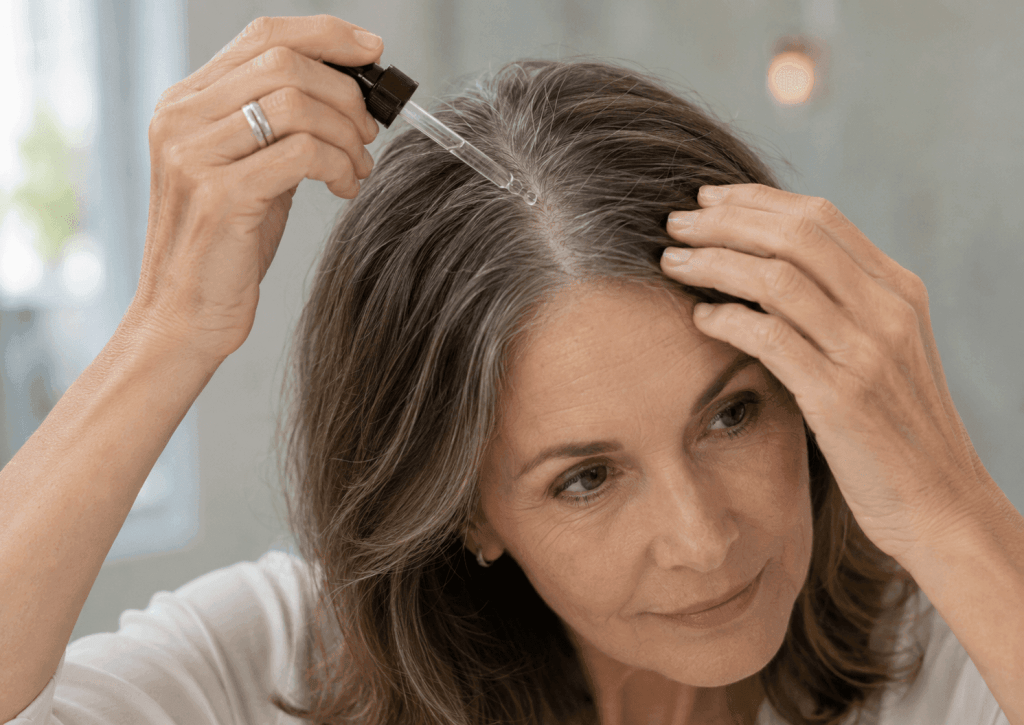
Why menopause hair thinning is not always solved by supplements or hormones
Menopause hair thinning is not always caused by nutrient deficiencies alone. In many women, the hair follicle environment itself changes with age, making regrowth slower and less predictable.
PubMed reports that menopausal hair symptoms can include reduced scalp hair growth and density, altered hair structure, and female-pattern hair loss.
Follicles may become less responsive with age
Hair follicles naturally cycle through growth, transition, resting, and shedding phases. During and after menopause, this cycle may shorten, leading to thinner, finer hairs and reduced overall density.
Pattern hair loss involves follicle miniaturization, decreased scalp coverage, and shortened terminal hair growth duration.
This is one reason many women notice:
- widening part lines
- reduced ponytail thickness
- increased scalp visibility
- slower regrowth after shedding
before they ever notice bald patches.
Supplements may help if a nutritional deficiency is contributing to shedding, but they may not directly address follicle signaling or scalp condition.
Scalp inflammation can disrupt the hair cycle
Scalp inflammation is increasingly discussed in hair-loss research because chronic follicle stress may interfere with normal hair cycling.
Journal of the American Academy of Dermatology notes that pattern hair loss involves follicle miniaturization and premature anagen termination, with mechanisms beyond androgen activity, especially in women.
This does not mean inflammation alone causes menopause hair loss. However, scalp health may influence:
- shedding intensity
- follicle function
- recovery speed
- visible density
That is one reason regenerative treatments often focus on the scalp environment rather than only stimulating growth.


What makes regenerative hair treatments different from traditional hair growth products
Regenerative hair treatments are designed to support communication between cells and follicles rather than simply increasing circulation or coating the hair shaft.
This is the core difference between stem cell hair serums and many traditional cosmetic hair products.
Growth factors and exosomes explained simply
Growth factors are signaling proteins involved in repair, communication, and tissue maintenance. Growth factors and peptides also appear in some facial products, including Korean face masks for mature skin, although scalp treatments and facial masks are not interchangeable. Exosomes are tiny extracellular vesicles that may help transport signaling molecules between cells.
In simple terms, regenerative serums are trying to create a healthier environment around the follicle.
That is different from:
- thickening shampoos, which mostly improve hair appearance
- supplements, which mainly support nutritional status
- minoxidil, which works through different growth-stimulation pathways
Why follicle signaling matters
Healthy follicles rely on constant cellular communication. Over time, follicles may become sluggish or miniaturized, especially in female pattern thinning associated with menopause.
Regenerative treatments aim to support:
- follicle activity
- scalp condition
- hair cycle balance
- hair shaft quality
This does not guarantee regrowth. But it may help explain why some women see improvements in shedding and hair density when using regenerative approaches consistently.
What women usually want to know before trying stem cell hair serum
Most women researching stem cell hair serum want to know three things:
- How soon results may appear
- Whether treatment needs to continue long-term
- Whether improvements are actually noticeable
Those are reasonable questions because regenerative hair treatments are rarely inexpensive, and expectations are often unrealistic online.
How soon results may appear
Visible hair changes usually take time because follicles cycle slowly.
Stem cell hair serums may have different timelines, but most regenerative hair treatments are also measured over weeks or months rather than days.
Calecim Professional claims that using its hair system on a consistent basis results in visible changes within 6-12 weeks.
Results can vary significantly depending on:
- how advanced thinning is
- scalp condition
- consistency of use
- genetics
- concurrent treatments
What improvements are realistic
Realistic improvements are usually subtle at first.
Women may notice:
- less shedding
- fuller-looking part lines
- improved texture
- thicker-feeling strands
- better scalp comfort
before dramatic regrowth.
According to Calecim Professional, the brand reports:
- 16% increase in hair shaft thickness
- 14% increase in hair count
- 15% increase in active follicles per square centimeter

Who is most likely to benefit from stem cell hair serum during menopause
Stem cell hair serum may be most relevant for women experiencing early-to-moderate thinning rather than severe long-term follicle loss.
Potential candidates include:
- women with widening part lines
- diffuse thinning across the scalp
- increased shedding during menopause
- people seeking non-drug alternatives
- women concerned about scalp health
These treatments may be less helpful if:
- follicles are severely scarred
- bald areas have been inactive for many years
- hair loss is caused by untreated medical conditions
People looking for a low-maintenance “quick fix” may also feel disappointed because regenerative treatments usually require consistency.
When minoxidil, hormone therapy, or regenerative treatments may make more sense
Different menopause hair loss treatments work in different ways. Choosing the right option depends on your goals, tolerance for side effects, and comfort level with ongoing treatment.
| Treatment | Main Goal | Best For | Limitations |
| Minoxidil | Stimulate growth cycle | Women wanting evidence-backed treatment | Requires long-term use |
| Hormone therapy | Address hormonal symptoms broadly | Women with multiple menopause symptoms | Not suitable for everyone |
| Stem cell hair serum | Support follicle signaling and scalp condition | Women seeking non-drug regenerative support | Evidence still emerging |
| Supplements | Correct deficiencies | Nutrient-related shedding | May not address follicle signaling |
How CALECIM® Professional Hair Serum approaches menopause-related hair thinning
CALECIM® Professional Hair Serum is a regenerative stem cell solution that targets follicle support, scalp preparation, and inflammation management.
According to Calecim Professional, the system includes a derma-stamper activator and a hair serum powered by PTT-6®.
PTT-6® and follicle signaling
According to Calecim Professional, PTT-6® contains over 3,000 proteins, including growth factors, cytokines, and exosomes.
The brand states that these ingredients are designed to support:
- follicle signaling
- scalp regeneration
- healthier hair cycling
- hair density
Calecim also reports a 24% increase in hair follicle cell production in in-vitro testing.
Scalp inflammation and hair shedding
According to Calecim Professional, the brand reports a 30x decrease in scalp inflammation markers during laboratory testing.
This aligns with broader hair-loss discussions around scalp environment and follicle stress, although direct clinical evidence in menopausal women remains limited.
Why treatment consistency matters
The Calecim Professional treatment phase involves twice-weekly application with the derma stamper over six weeks, followed by maintenance use.
Consistency matters because hair growth cycles move slowly. Irregular use may reduce the chance of noticeable improvement.
How to decide whether stem cell hair serum is worth trying for your hair goals
Stem cell hair serum may feel worth trying if you:
- want a non-drug option
- are noticing early menopause-related thinning
- are interested in scalp-focused regenerative support
- are comfortable with consistent treatment routines
It may not feel worthwhile if you:
- want immediate regrowth
- prefer treatments with stronger long-term clinical data
- are unwilling to maintain ongoing treatment
- expect guaranteed reversal of thinning
FAQ
Can dormant follicles reactivate?
Sometimes. Follicles that are miniaturized or sluggish may still produce hair under the right conditions, but follicles that are permanently scarred are less likely to recover.
Does menopause permanently damage follicles?
Not always. Menopause can contribute to follicle miniaturization and slower cycling, but some women still see improvements with consistent treatment and scalp support.
Are stem cell hair serums backed by research?
There is emerging research around exosomes, growth factors, and regenerative hair therapies, but menopause-specific clinical evidence remains limited..
Can hair density improve after menopause?
Yes, some women may see improved density or reduced shedding depending on the cause and severity of thinning.
Are results temporary?
Many hair-loss treatments require maintenance because thinning often progresses over time.
Is shedding normal early in treatment?
Sometimes. Changes in the hair cycle can temporarily increase shedding before stabilization occurs, although experiences vary between treatments.
Conclusion
Stem cell hair serums may be worth trying for menopause hair loss if you are looking for a non-drug, scalp-supportive approach.
The strongest evidence for female pattern hair loss still supports treatments like minoxidil. However, regenerative hair products are promising because they address follicle signaling, scalp condition, and long-term hair quality rather than simply stimulating growth.
CALECIM® Professional Hair Serum is a stem cell hair growth solution designed to support follicle activity and scalp health through PTT-6®, growth factors, cytokines, and exosome-related signaling proteins.
While I wait for gradual hair changes, I still enjoy the quicker confidence boost from my 25 mature-makeup tips—small changes to brows, lashes and complexion can make the whole face look more awake.
For women frustrated by thinning, widening part lines, or reduced density during menopause, the most important step is choosing a treatment approach with realistic expectations, consistent use, and evidence-informed decision-making.