
Foundation separating on mature skin is one of those makeup problems that can make you feel like you did everything right… and somehow your face still had other plans.
I know the look well.


The foundation looks smooth when I first apply it. Then a few hours later, it starts breaking apart around my nose, sitting strangely on dry patches, gathering in fine lines or looking patchy through the centre of my face. Sometimes it almost looks like the makeup is floating on top of the skin instead of becoming part of it.
And after 50, this can feel even more frustrating because our skin is not behaving the same way it did years ago.
Skin can become drier, thinner, more textured, more sensitive or more combination than it used to be. The foundation that looked beautiful in the morning can suddenly look cakey and separated by lunch.
But here is the good news: foundation separating on mature skin does not always mean the foundation is bad.
Often, it means one of three things is happening:
- The skin underneath is not prepped in the right way.
- The layers underneath foundation are not working together.
- Too much product is sitting on areas that move, crease or become oily.
Once I understood that, my makeup started lasting so much better.
In this guide, I am walking through why foundation separates on mature skin, how I stop it from breaking apart, how I fix it when it happens, and the simple mature skin foundation tips that make the biggest difference for me.
If you are still looking for formulas that behave better on fine lines and texture, my guide to the best foundations for mature skin that look smooth instead of cakey is a good next read. But first, let’s fix the routine, because even a lovely foundation can separate if the layers underneath are fighting each other.
Table of Contents
Why Foundation Separates on Mature Skin

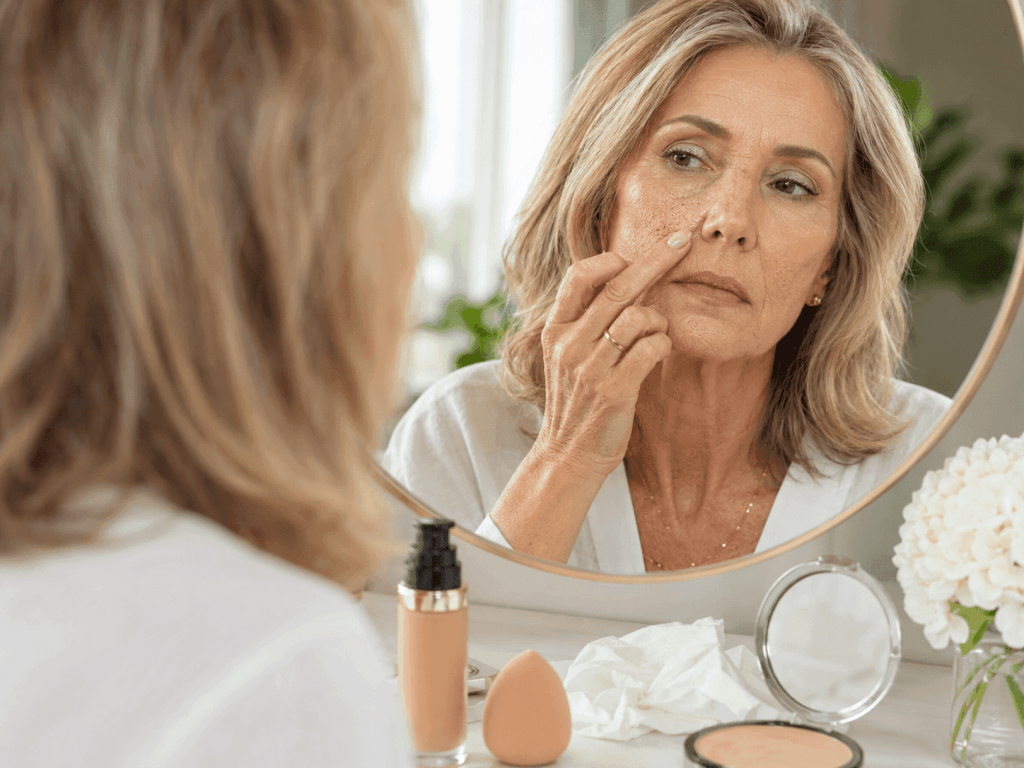
Foundation separates when the makeup no longer sits evenly on the skin.
Instead of looking smooth, it can:
- Break apart around the nose
- Look patchy on the cheeks
- Sit on top of dry flakes
- Gather in smile lines
- Look greasy through the T-zone
- Pill or roll up over skincare
- Look cakey and separated at the same time
On mature skin, this often happens because the skin surface is not as even or predictable as it once was.
The American Academy of Dermatology notes that as skin ages, it can become drier and fine lines become more noticeable, which is why daily moisturizer becomes more important in the 40s and 50s. That matters for makeup, because foundation behaves very differently over dry, tight skin than it does over skin that is lightly hydrated and comfortable.
But too much moisture can also cause problems.
This is the annoying part: mature skin can need hydration and still reject heavy layers under foundation.
That is why I think of foundation separation as a layering problem, not just a foundation problem.
The Biggest Reasons Foundation Breaks Apart After 50
When someone asks me, “Why does my foundation separate on mature skin?” I usually think about the whole routine before blaming the bottle.
These are the most common reasons I see.
1. The Skin Is Too Dry Underneath
Dry skin can make foundation cling, crack and separate, especially around the cheeks, mouth and forehead.
When the skin is dehydrated, foundation does not glide as easily. It can grab onto tiny dry patches, which makes the base look uneven even if the formula is good.
This is why I always prep first. My step-by-step guide to prepping mature skin before foundation explains this in more detail, but the short version is simple: foundation looks better when the skin underneath feels calm, hydrated and not overloaded.
2. The Skin Is Too Slippery Underneath
This is the opposite problem.
Sometimes foundation separating on mature skin happens because there is too much slip underneath it.
That can come from:
- A rich moisturizer
- A heavy sunscreen
- Too much facial oil
- A silicone primer layered over creamy skincare
- Not waiting between skincare and makeup
When the base underneath foundation is too emollient, the foundation can slide around instead of setting down.
This is especially common around the nose, chin and centre of the face.
3. Products Are Not Compatible
Foundation pilling on mature skin often happens when skincare, sunscreen, primer and foundation do not play well together.
Sometimes it is not about using “bad” products. It is about formulas that do not layer well.
For example:
- A water-light serum under a silicone-heavy primer
- A rich sunscreen under a matte long-wear foundation
- Too much moisturizer under a skin tint
- A gripping primer over skincare that has not absorbed
If your foundation rolls up, flakes or balls into tiny pieces, that is usually pilling rather than normal separation.
The fix is often fewer layers, thinner layers and more waiting time.
4. Too Much Foundation Is Applied
This one took me years to accept.
Sometimes foundation separates because I simply used too much.
Mature skin usually looks better with thin, flexible layers. When too much foundation sits around fine lines, smile lines or the nose, the excess product has nowhere to go. So it gathers, creases and breaks apart.
If your foundation is settling into wrinkles and separating, try using less foundation before buying a new one.
My post on foundations that do not settle into wrinkles on mature skin is helpful, but the application technique matters just as much as the formula.
5. Powder Is Added Too Late or Too Heavily
Powder can help foundation last, but it can also make separation worse if used the wrong way.
If makeup is already oily, sweaty or broken apart, adding powder directly on top can create a thick, patchy finish.
I always blot first, smooth the area, then add the tiniest amount of powder only where needed.
My full guide on how to apply setting powder for mature skin without emphasizing lines goes deeper, but the main rule is this: powder should set makeup, not rescue a heavy base.
My Quick Foundation Separation Fix Table
| Problem | What It Usually Means | What I Do First |
|---|---|---|
| Foundation separates around the nose | Too much oil, skincare slip or product build-up | Use less foundation, blot first, set lightly |
| Foundation separates on dry patches | Skin needs better hydration or gentle exfoliation | Prep with light moisture and avoid heavy powder |
| Foundation pills over sunscreen | Products are not layering well | Wait longer and press foundation instead of rubbing |
| Foundation looks cakey and separated | Too much product or powder | Thin layers, spot-conceal, mist lightly |
| Foundation settles into fine lines | Excess product is sitting in movement areas | Tap out creases before setting |
| Foundation breaks apart in hot weather | Heat, sweat and too many creamy layers | Simplify routine and set strategically |
How I Prep Mature Skin So Foundation Does Not Separate

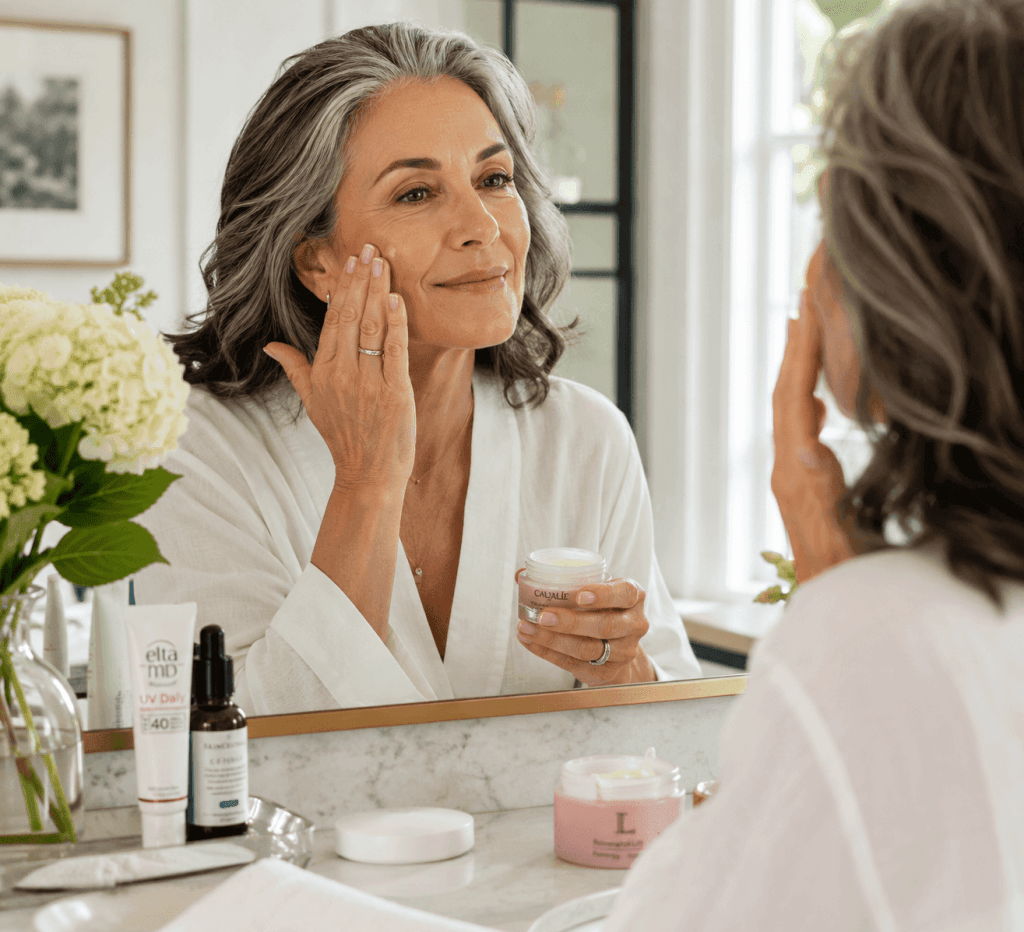
For me, the best fix starts before foundation.
I want my skin to feel hydrated, but not greasy. Comfortable, but not coated. Smooth, but not slippery.
My basic prep routine looks like this:
- Gentle cleanse or rinse.
- Apply a light moisturizer.
- Let it settle.
- Apply sunscreen if it is daytime.
- Let that settle too.
- Add primer only where needed.
- Apply foundation in a thin layer.
That waiting time matters.
Cleveland Clinic’s guide to proper skin-care product order explains the basic morning order as cleanser, serum, moisturizer and sunscreen, which is very close to how I think about makeup prep too. I want skincare to do its job before foundation arrives.
I do not want to mix foundation into wet moisturizer.
I do not want to smear foundation over sunscreen that has not settled.
And I do not want to use primer as a bandage over skincare that was already too heavy.
Is Your Moisturizer Making Your Foundation Separate?
Moisturizer is important for mature skin, but the texture matters.
A rich night cream can be wonderful before bed and completely wrong under makeup on a warm morning.
If your foundation is not sitting well on mature skin, look at your moisturizer first.
Ask yourself:
- Does my face still feel slippery 10 minutes after applying it?
- Does my foundation move around when I blend?
- Does makeup separate faster in the areas where I applied the most cream?
- Does my skin feel hydrated or coated?
For daytime makeup, I usually prefer a light moisturizer that absorbs well. If my skin is very dry, I apply a little more on the dry areas only rather than using a heavy layer everywhere.
Cleveland Clinic explains that moisturizers help support the skin’s protective barrier, which is exactly what dry mature skin needs. But under makeup, I still want the finish to be smooth rather than greasy.
A good rule is this: if your skin still feels wet or oily before foundation, wait longer or use less next time.
How to Stop Foundation Separating Over Sunscreen


Foundation separating over sunscreen is incredibly common.
And it is frustrating because sunscreen is not optional, especially if you care about mature skin.
The American Academy of Dermatology recommends choosing a broad-spectrum, water-resistant sunscreen with SPF 30 or higher. Their guidance on how to apply sunscreen properly also reminds us to use enough product, which matters because a tiny dab is not real protection.
But here is the makeup problem: the amount of sunscreen we need for proper protection can be more than our foundation wants to sit on top of.
So I handle sunscreen carefully.
My sunscreen-under-foundation rules:
- I apply sunscreen after moisturizer.
- I give it time to settle.
- I do not rub foundation aggressively over it.
- I press foundation on with fingers, sponge or brush.
- I use less foundation over areas that already feel dewy.
- I avoid adding too much primer unless I know it works with that sunscreen.
If sunscreen causes pilling, I do not immediately blame the sunscreen. I test it with a simpler routine.
One day, I try sunscreen plus foundation only. No serum. No primer. No extra oil. That helps me see whether the issue is the sunscreen itself or the whole stack underneath.
If you prefer lighter summer base products, my guide to tinted moisturizers with SPF for women over 50 may help, but I still treat SPF makeup as a beauty layer rather than my only sunscreen plan.
Why Foundation Separates Around the Nose


Foundation separating around the nose is probably the most common complaint I hear.
It happens because the nose area is busy.
There is natural oil, texture, movement, redness, pores, sunscreen, moisturizer and sometimes more product because we are trying to cover redness.
So the first thing I do is apply less foundation around the nose, not more.
I know that sounds strange, because redness around the nose can make us want more coverage. But a thick layer in that area is much more likely to break apart.
My method:
- Apply a thin layer of foundation around the nose.
- Let it sit for a moment.
- Tap with a sponge to remove excess.
- Add a tiny dot of concealer only where redness remains.
- Set with a very small brush and a whisper of powder.
If foundation separating around the nose keeps happening, I also check my skincare. Sometimes moisturizer or sunscreen collects in the folds beside the nose, and then foundation slips right over it.
For redness-prone skin, my base routine for covering redness and rosacea after 50 without looking cakey is useful because it focuses on targeted correction rather than heavy all-over coverage.
How to Stop Foundation Separating on Dry Mature Skin
Foundation separating on dry mature skin usually looks like patchiness, flaking or uneven texture.
The foundation may cling to areas you did not even know were dry.
For dry mature skin, I focus on:
- Gentle cleansing
- Light but effective hydration
- Avoiding too much powder
- Choosing flexible foundation
- Pressing makeup into the skin rather than dragging it
- Using setting spray to soften the finish
I do not like using a heavy scrub right before makeup. If the skin barrier feels irritated, makeup usually looks worse. Cleveland Clinic lists dryness, rough patches, inflammation and sensitivity as possible signs of a damaged skin barrier, and I find that makeup is much more likely to separate when my skin feels irritated or overworked.
For dry skin, a satin or softly radiant foundation is often easier than a very matte one.
If you love a polished base but your skin feels dry, reviews like my Lancôme Rénergie Lift Foundation SPF 27 wear test for mature skin can help you compare formulas that feel more comfortable than heavy matte bases.
How to Stop Foundation Separating on Oily or Combination Mature Skin
Not all mature skin is dry.
Many of us have combination skin: dryness on the cheeks, shine around the nose, maybe a little oil on the chin, and foundation disappearing from the centre of the face.
Foundation separating on oily mature skin usually looks like the base breaking apart, especially in the T-zone.
My fix is not to make the entire face matte.
Instead, I treat different zones differently.
For oily or combination mature skin:
- Use lightweight moisture everywhere.
- Use a smoothing or gripping primer only where makeup breaks apart.
- Apply less foundation through the T-zone.
- Choose a satin or natural finish rather than a very dewy one.
- Powder lightly before the foundation has a chance to slide.
- Blot before touch-ups.
My guide to matte vs dewy makeup on mature skin explains why I often prefer a satin middle ground. It gives mature skin life without letting the centre of the face become too shiny.
If you want a stronger long-wear option for events, my Estée Lauder Double Wear review on mature skin shows how I use a fuller-coverage foundation without letting it look heavy.
The Primer Mistake That Can Make Foundation Pill or Separate
Primer can help, but primer can also cause trouble.
The biggest mistake is using primer everywhere without asking what you need it to do.
A hydrating primer may help dry areas, but it can make the nose too slippery. A gripping primer may help the T-zone, but it can make dry cheeks look tight. A silicone smoothing primer can blur texture, but it may pill if layered over the wrong skincare.
That is why I use primer strategically.
If my cheeks are dry, I may use a hydrating primer there.
If my nose separates, I may use a tiny amount of smoothing or gripping primer only around the nose.
If my sunscreen already gives a smooth finish, I may skip primer completely.
My best primers for mature skin guide is helpful if you are trying to decide between hydrating, smoothing and gripping options. And if you are still wondering whether primer is even necessary, my post on whether older women really need primer breaks it down more gently.
The point is not to own more primer. The point is to use the right kind in the right place.
How I Apply Foundation So It Does Not Separate
When foundation separates after 50, application matters just as much as product choice.
I rarely apply foundation straight from the bottle all over my face.
Instead, I start small.
My method:
- Place a little foundation on the back of my hand.
- Dot it only where I need coverage.
- Blend from the centre of the face outward.
- Use thin layers.
- Press over texture rather than rubbing.
- Tap away excess around the nose and mouth.
- Add concealer only where needed.
A damp sponge can help remove extra product. A small brush can help place coverage exactly where I want it. Fingers can help melt a lightweight formula into the skin.
If your foundation often looks patchy on mature skin, tools can make a big difference. My guide to foundation brushes and sponges for mature skin is useful if you are not sure whether a sponge, brush or fingers suit your formula best.
How I Fix Separated Foundation Without Starting Over

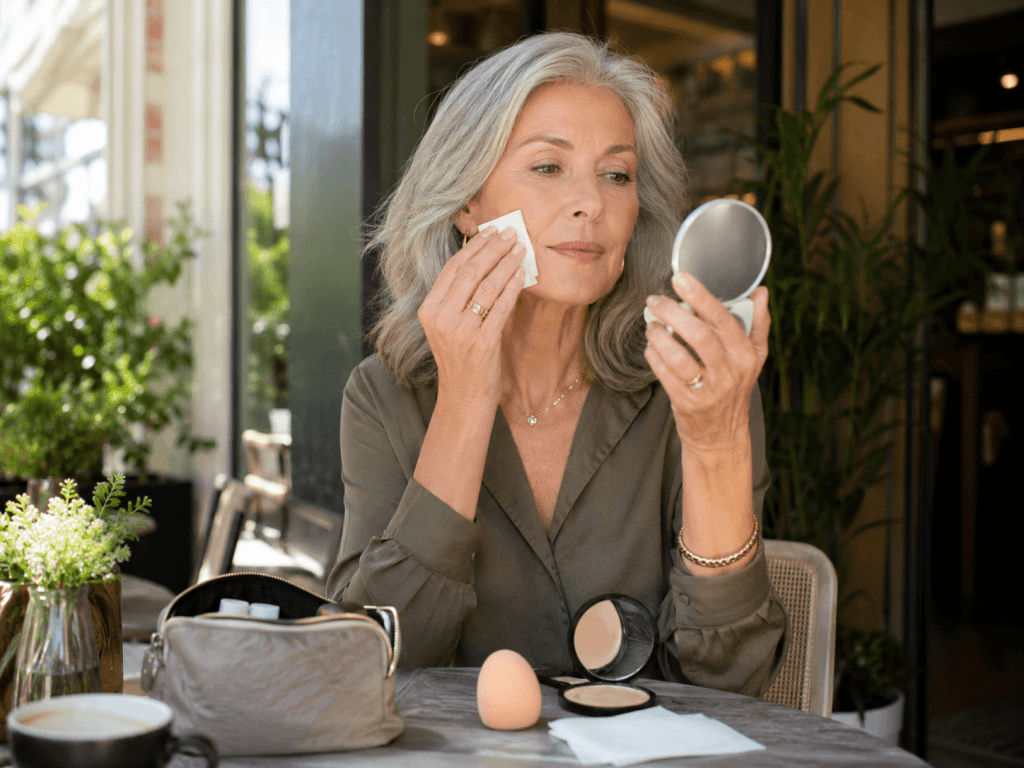
If foundation has already separated, I do not automatically wash my face and start again.
Most of the time, I can repair it.
Step 1: Blot first
I gently press tissue or blotting paper over the separated area. I do not rub.
If there is oil or moisture sitting on top, powder will not fix it until I remove that first.
Step 2: Smooth the product
I use a clean fingertip or sponge to tap the foundation back into place.
This works especially well around the nose and smile lines.
Step 3: Add the smallest amount of coverage
If a spot has lost coverage, I add a tiny dot of concealer rather than more foundation.
My concealer guide for mature skin without creasing is helpful here because concealer can either save the base or make it look thicker if used too heavily.
Step 4: Set only where needed
Once the makeup looks smooth again, I set with the smallest amount of powder.
Step 5: Mist lightly
If the area looks dry or powdery, I use a light setting spray.
My post where I tested setting sprays after 50 for fresh makeup that does not feel tight is perfect if you want a spray that helps the makeup look softer rather than stiff.
Best Foundation Types for Mature Skin That Separates Easily
If your foundation separates no matter what you do, the formula may not be the best match.
I usually prefer foundations that are flexible rather than thick.
For mature skin that separates easily, I look for:
- Lightweight liquid texture
- Buildable coverage
- Satin or natural finish
- Enough hydration to avoid patchiness
- Enough set to avoid sliding
- A formula that works in thin layers
I am careful with very matte formulas on dry skin and very dewy formulas on oily areas.
The best foundation for mature skin is rarely the one that promises the most coverage. It is the one that still looks good after real life: talking, smiling, sunscreen, heat, coffee, errands and a few hours of movement.
If you are deciding between formulas, my foundation guide for mature skin and my summer makeup routine for mature skin both help connect formula choice with real wear.
My Step-by-Step Routine to Keep Foundation Smooth All Day
Here is the routine I would use if my foundation had been separating lately.
1. Start with calm skin
No harsh scrubbing right before makeup. I want the skin to feel comfortable before I start.
2. Use light hydration
I apply moisturizer, then wait until the skin feels soft but not slippery.
3. Apply sunscreen carefully
For daytime, sunscreen goes under makeup. I apply enough, let it settle, then avoid rubbing foundation aggressively on top.
4. Use primer only where needed
I do not prime my whole face just because I own primer. I use it where makeup separates, pills or fades.
5. Apply less foundation than I think I need
This is the biggest fix. I start thin, then build only in small areas.
6. Spot-conceal
I cover redness, darkness or spots with concealer instead of adding a second full layer of foundation.
7. Tap out lines before setting
Before powder, I check smile lines, under-eyes and the sides of the nose. If product has gathered, I tap it out first.
8. Powder strategically
I set only the centre of the face, not the whole face.
9. Use setting spray if needed
A light mist can make the base look more seamless and less powdery.
10. Blot before touch-ups
If makeup separates later, I blot first and add product second.


Final Thoughts: Foundation Separation Is Usually Fixable
Foundation separating on mature skin can feel so frustrating, but it is usually fixable.
It does not mean your skin is bad. It does not mean you cannot wear foundation. And it does not always mean you bought the wrong product.
Most of the time, the answer is softer prep, fewer layers, better waiting time and more targeted application.
After 50, I find that foundation looks best when I stop trying to cover everything and start working with the skin I have now.
Thin layers. Gentle prep. Strategic powder. A little patience.
That is the routine that helps my foundation look smoother, fresher and far less likely to break apart by midday.
Have you struggled with foundation separating around the nose, over sunscreen or on dry patches? I would love to know what finally helped your base look smooth again — tell me in the comments.
FAQ: Foundation Separating on Mature Skin
Why does my foundation separate on mature skin?
Foundation separates on mature skin when the makeup stops sitting evenly on the surface of the face. Instead of looking smooth and blended, it can start to break apart, gather in fine lines, cling to dry patches or slide around the nose and chin.
After 50, this can happen more easily because our skin often changes texture. It may become drier on the cheeks, oilier around the nose, more sensitive, or more textured than it used to be. That means the foundation has to work harder, and the routine underneath matters even more.
The most common reasons I see are:
- Too much moisturizer underneath
- Not enough hydration underneath
- Sunscreen that has not settled
- Primer that does not match the foundation
- Too much foundation applied at once
- Powder added over oil or shine
- Foundation sitting in lines before it is set
Before blaming the bottle, I always check the prep. My step-by-step guide to prepping mature skin before foundation is the first place I would start if your base keeps breaking apart.
If the problem is mainly your formula, then compare it with my best foundations for mature skin that look smooth instead of cakey, because some foundations simply behave better on mature texture than others.
How do I stop foundation from separating after 50?
To stop foundation from separating after 50, I focus on lighter layers, better waiting time, and targeted setting.
I do not try to force foundation to stay put by adding more product. That usually makes the separation worse. Instead, I use less foundation and place it more carefully.
My basic routine is:
- Apply light moisturizer.
- Let it settle.
- Apply sunscreen if it is daytime.
- Let that settle too.
- Use primer only where needed.
- Apply foundation in a thin layer.
- Add concealer only where extra coverage is needed.
- Tap out creases before powder.
- Set only the areas that move or become shiny.
That routine keeps the skin smoother without creating a thick layer that can crack, slip or separate.
If you are not sure which order your products should go in, my exact makeup layering routine for mature skin is a really useful companion post. Product order matters so much, especially when foundation is separating after 50.
I would also read my summer makeup routine for mature skin if your foundation separates more in heat, humidity or long days outside.
Why does my foundation separate around my nose?
Foundation separates around the nose because that area has a lot going on. There is natural oil, redness, texture, pores, movement, sunscreen, moisturizer and sometimes too much foundation because we are trying to cover redness.
The nose is one of the worst places to apply a thick layer of foundation.
If I apply too much product around my nose, it may look covered at first, but a few hours later it breaks apart. The foundation starts sitting in the little folds beside the nostrils, or it becomes patchy across the tip of the nose.
My fix is simple:
- Use less moisturizer around the nose
- Let sunscreen settle properly
- Apply a tiny amount of foundation
- Tap away excess with a sponge
- Add concealer only where redness remains
- Set with a small brush and a tiny bit of powder
If redness around the nose is the reason you keep adding more base, my routine for covering redness and rosacea after 50 without looking cakey will help a lot. It shows how to cover redness in targeted layers instead of making the whole face heavier.
For setting this area, I would also use the lightest touch from my setting powder technique for mature skin.
Why does my foundation separate over sunscreen?
Foundation separates over sunscreen when the sunscreen layer is too slippery, too thick, not fully settled, or simply not compatible with the foundation on top.
This does not mean you should skip sunscreen. It means the layers need to be handled more carefully.
Sunscreen is often more generous than moisturizer, because we need enough for proper protection. But that also means foundation can slide if I apply it too quickly. If I rush, the sunscreen and foundation almost mix together instead of layering neatly.
What helps me:
- Apply sunscreen after moisturizer
- Wait until it feels settled
- Press foundation on instead of rubbing
- Use less foundation over very dewy areas
- Skip primer unless I know it works with that sunscreen
- Avoid heavy creams underneath SPF during the day
If you like SPF in your base products, my tinted moisturizers with SPF for women over 50 post is helpful. I still treat SPF makeup as a beauty layer, not my entire sun protection plan, but tinted SPF products can feel easier on warm days.
For a full routine built around heat and SPF, link this FAQ naturally to my summer makeup guide for mature skin.
Can too much moisturizer make foundation separate?
Yes, too much moisturizer can absolutely make foundation separate.
This is one of the sneakiest problems because mature skin often does need more moisture. But there is a difference between skin that feels hydrated and skin that feels slippery.
Foundation usually loves hydrated skin. It does not always love a rich cream sitting on top of the skin.
Signs your moisturizer may be causing foundation separation:
- Foundation slides while you blend
- Your face looks shiny before makeup is finished
- Foundation separates faster where you applied the most cream
- Makeup feels tacky or heavy
- Powder looks patchy on top
The fix is not to stop moisturizing. The fix is to choose the right texture for daytime.
I save richer creams for night and use something lighter under makeup. If my cheeks are dry but my nose is oily, I prep those areas differently. Mature skin does not always need the same amount of moisturizer everywhere.
If your base keeps slipping, go back to the routine in my how to prep mature skin for foundation guide. Then compare that with my makeup layering routine for mature skin to make sure your moisturizer, sunscreen, primer and foundation are in the right order.
Does primer stop foundation from separating on mature skin?
Primer can stop foundation from separating on mature skin, but only if it matches the problem.
I do not think primer should be used automatically all over the face. I use it like a targeted helper.
If foundation separates because your cheeks are dry, a hydrating primer may help. If foundation separates because your nose gets oily, a smoothing or gripping primer may help. If foundation pills because there are already too many layers, adding primer can make things worse.
That is why I ask:
- Where does my foundation separate?
- Is that area dry, oily or textured?
- Do I need hydration, grip or smoothing?
- Does this primer work with my sunscreen?
- Does this primer work with my foundation?
For mature skin, I prefer a small amount of primer pressed into the problem area. I do not want a thick layer sitting over the whole face.
If you need help choosing the right category, my best primers for mature skin is the main post I would link here. If you want a softer explanation before buying anything, my guide on whether women over 50 really need primer is a better starting point.
Why does my foundation look patchy after a few hours?
Foundation looks patchy after a few hours when the base breaks down unevenly.
This can happen from dryness, oil, sweat, sunscreen, product incompatibility or simply too much foundation sitting on the skin. On mature skin, patchiness often shows first on the cheeks, around the nose, between the brows or near smile lines.
If your skin is dry, foundation can cling to tiny flakes. If your skin is oily, foundation can slide and separate. If your powder is too heavy, certain areas can look dry and others can still look shiny.
My patchy-foundation fix is:
- Use gentle skin prep
- Apply less foundation
- Blend with a sponge to remove excess
- Spot-conceal instead of layering
- Powder only where needed
- Blot before touch-ups
- Use setting spray if the finish looks dry
If patchiness happens because your powder is too heavy, read my best setting powders for mature skin and my setting powder application guide. The right powder helps, but the technique is what keeps it from looking dry or uneven.
If patchiness happens because your foundation formula is wrong, my best foundation for mature skin guide is the better internal link.
How do I fix separated foundation without washing my face?
You can often fix separated foundation without washing your face, but the mistake is adding more foundation right away.
When foundation separates, I repair it in this order:
- Blot first.
- Smooth the area.
- Add tiny coverage only if needed.
- Set lightly.
- Mist if the area looks dry.
Blotting comes first because powder over oil or sweat can turn patchy. I gently press tissue or blotting paper over the separated area without rubbing. Then I use a clean fingertip or sponge to tap the foundation back into place.
If coverage is missing, I add a tiny dot of concealer, not another layer of foundation. A small amount of concealer is easier to control and less likely to make the whole face look thick.
For that step, link to my best concealers for mature skin that do not age the under-eye area, especially if the reader struggles with extra coverage that creases.
Then, if the repair looks too shiny, I add a tiny amount of powder. If it looks too dry, I use a comfortable mist from my setting sprays I tested after 50 post.
Is powder or setting spray better for foundation separation?
Powder and setting spray do different jobs, so I like both — but carefully.
Powder helps control oil, shine and movement. Setting spray helps the finished makeup look softer, fresher and less powdery.
If foundation separates because of oil around the nose or chin, powder usually helps more. If foundation looks dry, cakey or powdery, setting spray may help more.
The best routine for mature skin is usually:
- Thin foundation first
- Tap out creases
- Powder only where needed
- Mist lightly if the finish looks too dry
The problem is overusing either one.
Too much powder can make mature skin look dry and textured. Too much dewy setting spray can make oily areas break apart faster. I want balance.
For powder help, I would link to my best setting powders for mature skin and my how to apply setting powder without emphasizing lines guide.
For spray help, my setting spray test after 50 is the natural next step.
What type of foundation is best for mature skin that separates?
The best foundation for mature skin that separates is usually lightweight, flexible and buildable.
I look for formulas that can be applied thinly but still even out the skin. A foundation does not need to be heavy to look polished.
Good options often include:
- Satin liquid foundations
- Lightweight serum foundations
- Skin tints
- Tinted moisturizers
- Flexible long-wear foundations
- CC creams for targeted coverage
I am careful with very matte foundations if my skin is dry. I am also careful with very dewy formulas if my T-zone becomes oily.
The finish I usually like best is satin. It gives mature skin life without looking greasy, and it often wears better than very glowy formulas in the centre of the face.
To help readers choose, link to your best foundations for mature skin. You can also link to foundations that do not settle into wrinkles because separation and settling often happen together.
For lighter base days, my best tinted moisturizers for mature skin is another strong internal link.
Why does foundation separate in fine lines and wrinkles?
Foundation separates in fine lines and wrinkles when too much product sits in areas that move.
Smile lines, forehead lines and under-eye lines naturally shift as we talk, smile and blink. If there is a thick layer of foundation or concealer there, the product can gather, crease and eventually break apart.
The fix is not to avoid foundation completely. The fix is using less product in those areas.
I apply foundation very thinly over fine lines, then tap away excess with a sponge. Before setting, I check the lines again. If product has collected, I smooth it first. Powdering over creased foundation only locks the crease in place.
This is where formula choice matters too. Heavy, dry or stiff foundations can make fine lines look more obvious. More flexible formulas usually look softer.
For formula help, link to my foundations that do not settle into wrinkles on mature skin. For technique, link to my foundation brushes and sponges for mature skin because the right tool can remove excess product before it settles.
How can I stop foundation from separating in smile lines?
To stop foundation from separating in smile lines, use less product around the mouth and tap out the area before setting.
Smile lines move all day. That is normal. If a thick foundation layer sits there, it will usually gather as soon as you talk, laugh or drink coffee.
My smile-line method is:
- Apply foundation lightly around the mouth.
- Blend with a damp sponge.
- Wait one minute.
- Smile gently and check the lines.
- Tap out any collected product.
- Set with a tiny amount of powder only if needed.
I do not bake smile lines. Heavy powder in that area can make the skin look dry and more lined.
If you need more coverage around the mouth because of discoloration, use a tiny amount of concealer only where the tone is uneven. Do not add a second full layer of foundation.
exact makeup layering routine for mature skin and my concealer guide for mature skin, because smile-line separation is often caused by too much product in the wrong order.
Why does my foundation look cakey and separated?
Foundation looks cakey and separated when there is too much product, too much powder or too many layers that are not blending well together.
This usually starts with good intentions. We add more foundation for coverage, more concealer for brightness, more powder for staying power and then more product for touch-ups. By midday, the base looks thick but somehow still uneven.
That is the classic cakey-and-separated look.
To fix it, I would do the opposite:
- Less foundation
- More targeted concealer
- Powder only where needed
- Blot before touch-ups
- Use setting spray to soften powder
- Choose a foundation that works in thin layers
If your foundation often looks cakey, link to my common foundation mistakes on mature skin. That post supports this answer perfectly because caking usually comes from technique, not just product.
How do I stop foundation from clinging to dry patches?
Foundation clings to dry patches when the skin surface is rough, flaky or dehydrated.
The first fix is not more foundation. It is better prep.
Before makeup, I want the skin to feel calm and lightly hydrated. I avoid harsh scrubbing right before foundation because irritated skin can look worse under makeup. A gentle moisturizer, a hydrating primer on dry zones, and a flexible foundation usually work better.
When applying foundation, I press rather than drag. A damp sponge can help soften the finish and remove excess product.
If a dry patch still shows, I do not keep layering foundation over it. That usually makes the patch stand out even more. I gently tap the area with a tiny amount of moisturizer on a clean fingertip, then blend the foundation edges carefully.
how to prep mature skin before foundation guide and my best primers for mature skin, because dry patches usually need better skin prep before they need more makeup.
Why does foundation separate in hot weather?
Foundation separates in hot weather because heat, sweat, oil, sunscreen and humidity can all break down makeup faster.
This is especially true if the routine underneath is rich or if the foundation layer is thick. A heavy base may look nice for the first hour, but once heat gets involved, it can start sliding, creasing or separating around the nose and chin.
In hot weather, I simplify everything.
My warm-weather base is usually:
- Light moisturizer
- Sunscreen with enough settling time
- Minimal primer
- Thin foundation
- Targeted concealer
- Light powder through the centre
- Setting spray only if needed
- Blotting during the day
I also choose my foundation based on the day. For a casual hot day, I may prefer a tint or CC cream. For a summer event, I may use something longer-wearing, but still apply it thinly.
Can skincare cause foundation to separate?
Yes, skincare can absolutely cause foundation to separate.
This is one of the most common reasons makeup separates on mature skin. The skincare underneath may be too rich, too oily, too sticky, not fully absorbed or incompatible with the primer and foundation on top.
But the opposite can also happen. If the skin has too little moisture, foundation can cling, crack and look patchy.
So skincare can cause separation in both directions: too much or too little.
To test this, simplify your morning routine for a few days.
Try:
- Moisturizer
- Sunscreen
- Foundation
Skip extra oils, heavy serums and new primers. If your foundation suddenly wears better, one of the skipped products may have been the problem.
Should I use less foundation if it keeps separating?
Yes, using less foundation is one of the best first steps if your foundation keeps separating.
I know that sounds too simple, but it works.
When foundation separates, the natural instinct is to apply more coverage. But more product usually means more texture, more movement and more chance for the base to break apart.
Mature skin usually looks smoother with thin layers.
Try using half the amount of foundation you normally use. Apply it only where you need evening out, then step back and check your face in natural light.
If you still need coverage, add concealer to specific areas instead of applying another full layer.
For this answer, link to your best foundation brushes and sponges for mature skin because tools help control the amount of product. Also link to your best concealers for mature skin because concealer is the smarter way to add coverage without making the whole base heavier.
How long should I wait between skincare and foundation?
I like to wait until each skincare layer feels settled before applying foundation.
That usually means a few minutes after moisturizer and a few minutes after sunscreen. You do not need to stand around forever, but you do want to avoid blending foundation into wet skincare.
A simple touch test helps.
If your skin feels soft and comfortable, you are probably ready. If it feels slippery, tacky or wet, wait a little longer.
When I am in a rush, I apply skincare first, then do something else for a few minutes — brush my teeth, make coffee, fix my hair, or choose my lipstick. Then I come back to foundation.
This tiny pause can make foundation sit much better.
Does oily mature skin make foundation separate faster?
Oily mature skin can make foundation separate faster, especially around the nose, chin and forehead.
But oily mature skin still needs gentle prep. Skipping moisturizer completely can sometimes make foundation look worse, especially if the skin becomes dehydrated underneath.
The best approach is balance.
Use a light moisturizer, let it settle, then apply primer only where makeup breaks apart. Choose a foundation that has a natural or satin finish rather than something extremely dewy. Set the T-zone lightly before it becomes shiny.
During the day, blot before powdering. This keeps the foundation from becoming thick and patchy.
If your cheeks are dry but your nose is oily, prep them differently. Mature skin often needs zone-by-zone makeup.
How do I make foundation last all day on mature skin?
To make foundation last all day on mature skin, focus on thin layers, good prep and strategic setting.
A long-wearing foundation can help, but it will still look heavy if too much is applied. A lightweight foundation can last beautifully if the layers underneath are right.
My all-day routine is:
- Prep the skin gently.
- Use moisturizer that absorbs well.
- Apply sunscreen and let it settle.
- Prime only problem areas.
- Apply thin foundation.
- Use concealer for extra coverage.
- Tap out creases before powder.
- Powder only the centre of the face.
- Use setting spray if needed.
- Blot before touch-ups.
The foundation itself matters, but the routine matters more.
What is the fastest way to stop foundation separating?
The fastest way to stop foundation separating is to simplify your routine.
If my foundation is separating badly, I do not add more products. I remove the extras and test the basics.
The next day, I would do:
- Light moisturizer
- Sunscreen, settled properly
- No all-over primer
- Thin foundation
- Concealer only where needed
- Powder only around the nose and chin
- Setting spray only if the finish looks too powdery
Then I watch how the foundation wears.
If it still separates, I change one thing at a time. I test a different moisturizer, then a different sunscreen, then a different primer, then a different foundation.
Changing everything at once makes it impossible to know what fixed the problem.
Foundation separating on mature skin is frustrating, but it is not random. Once you understand whether the problem is dryness, oil, sunscreen, primer, powder or too much product, the fix becomes much easier.